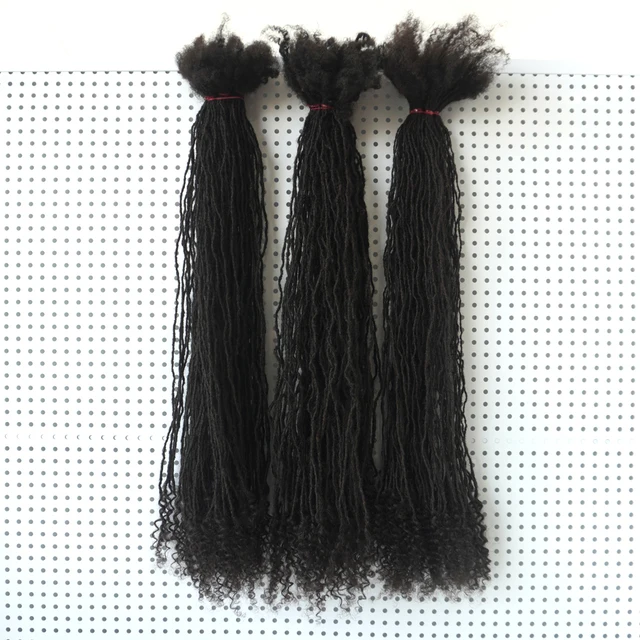
Buyers often treat strand gauge as one line item among many on a specification sheet. In micro loc work it is the specification that determines everything downstream: how the grid closes across the scalp, how long the installation runs, and how long the client sits in the chair for every retightening afterwards.
1. Grid Density Drives Scalp Coverage
A finer gauge lets the stylist build a tighter root grid, which reads as fuller coverage on the same head of natural hair. That fullness is not purely aesthetic. On clients with finer natural density, a tighter grid distributes tension across more anchor points, so each individual loc carries less load. On clients with dense, coily natural hair, the same tight grid can become crowded at the root and drive unnecessary retightening labour.
2. Choosing Gauge by Client Density and Aftercare
Match gauge to natural density first, then to the client's aftercare commitment. Clients who follow a disciplined washing and moisturising routine maintain a finer grid well; clients who wash infrequently or sleep without protection will shed natural hair into a fine grid and create matting at the root. For those clients, the coarser gauge is the more honest recommendation even though it produces a slightly broader loc.
3. Planning the Full-Head Strand Count
Never order strand counts from a generic chart. Count the smallest scalp section, measure it, extrapolate across the whole head, then add a working allowance for the crown and perimeter where density is usually thinnest. Record the final count and the gauge used in the client's file so the next retightening order matches the original installation rather than introducing a gauge change that the client will feel immediately.